
What Is a Geothermal Loop Field?
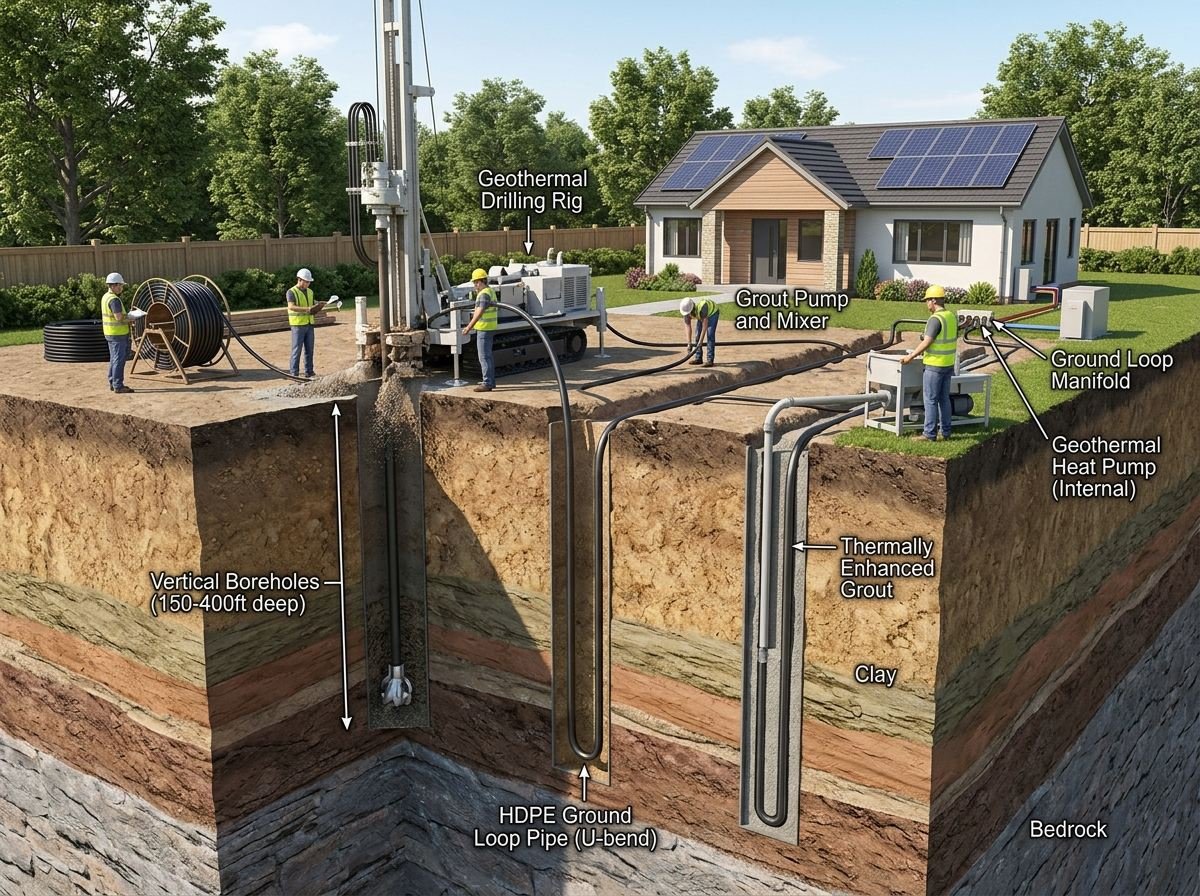
A geothermal loop field is a network of pipes buried in the ground around your property. It circulates a water-based fluid that absorbs heat from the earth in winter and releases heat back into the ground in summer. This continuous loop of heat exchange is what makes geothermal systems so efficient — instead of generating heat, they move it.
The loop field is the longest-lasting component of any geothermal system. Properly installed using high-density polyethylene (HDPE) pipe with heat-fused joints, a ground loop requires virtually no maintenance and is designed to last 50 years or more. Getting the loop field right is critical — its size, configuration, and installation quality directly affect how efficiently the system will perform for decades to come.
At Calgary Geothermal, loop field installation is a core part of what we do. We assess each property individually, select the right loop configuration for the site, handle all drilling or excavation, and pressure-test every loop before backfill. We don't subcontract this work — our own crew manages every phase from ground-breaking to final commissioning.
Loop Field Configurations
The right loop configuration depends on your property's lot size, soil type, available land, and the depth of stable ground temperatures. Calgary Geothermal installs all major loop types and will recommend the best option for your specific site.
Vertical Closed-Loop
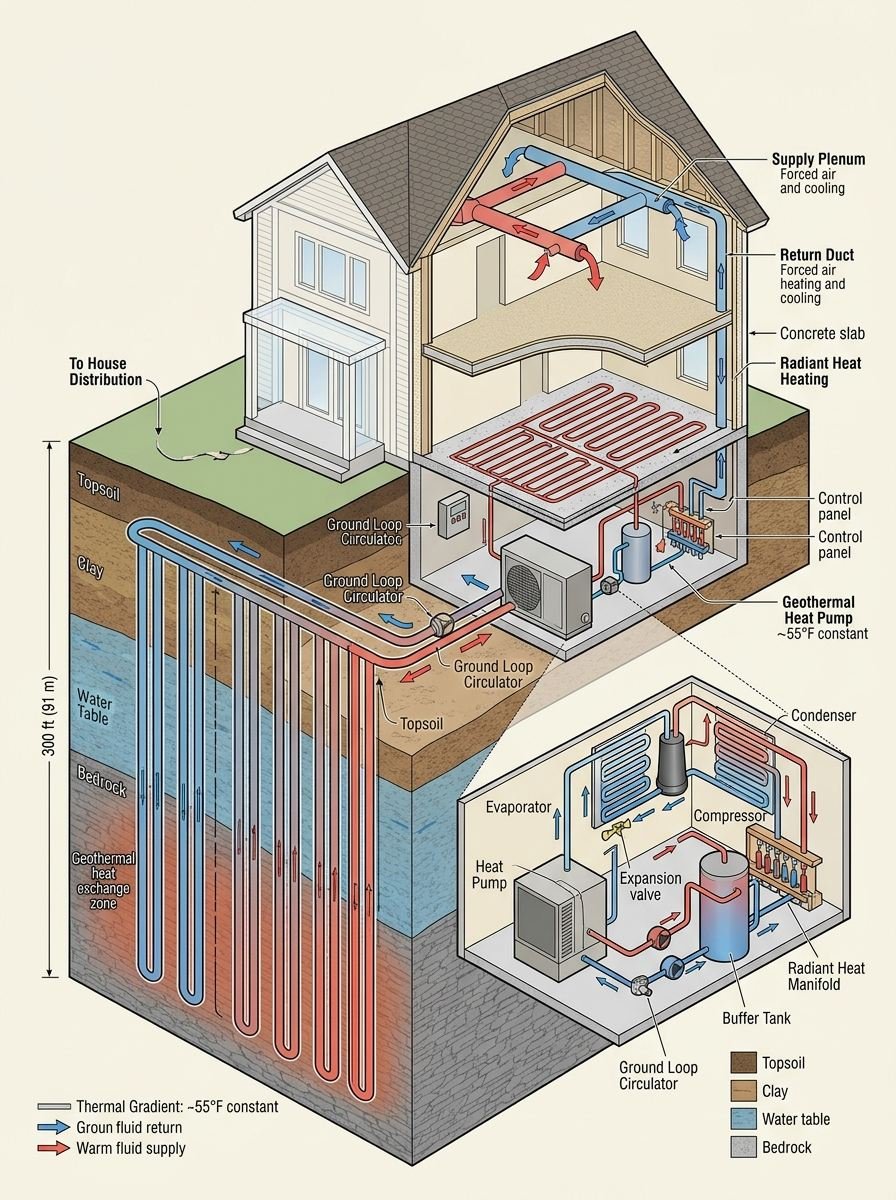
Vertical loops are the most common loop configuration in Calgary. Boreholes are drilled straight down to depths of 150 to 400 feet, and U-shaped pipe loops are inserted and grouted in place. Vertical loops require a smaller footprint than horizontal systems, making them well-suited for residential and commercial properties with limited land area.
Because vertical boreholes reach deeper, more stable ground temperatures, vertical systems tend to perform consistently and efficiently throughout Calgary's heating season. They are also less disruptive to landscaping since the surface disturbance is limited to the borehole locations and header trench.
- Ideal for smaller lots or limited surface area
- Reaches deeper, more stable ground temperatures
- Minimal landscaping disruption
- Most common configuration for Calgary residential installs
Horizontal Closed-Loop
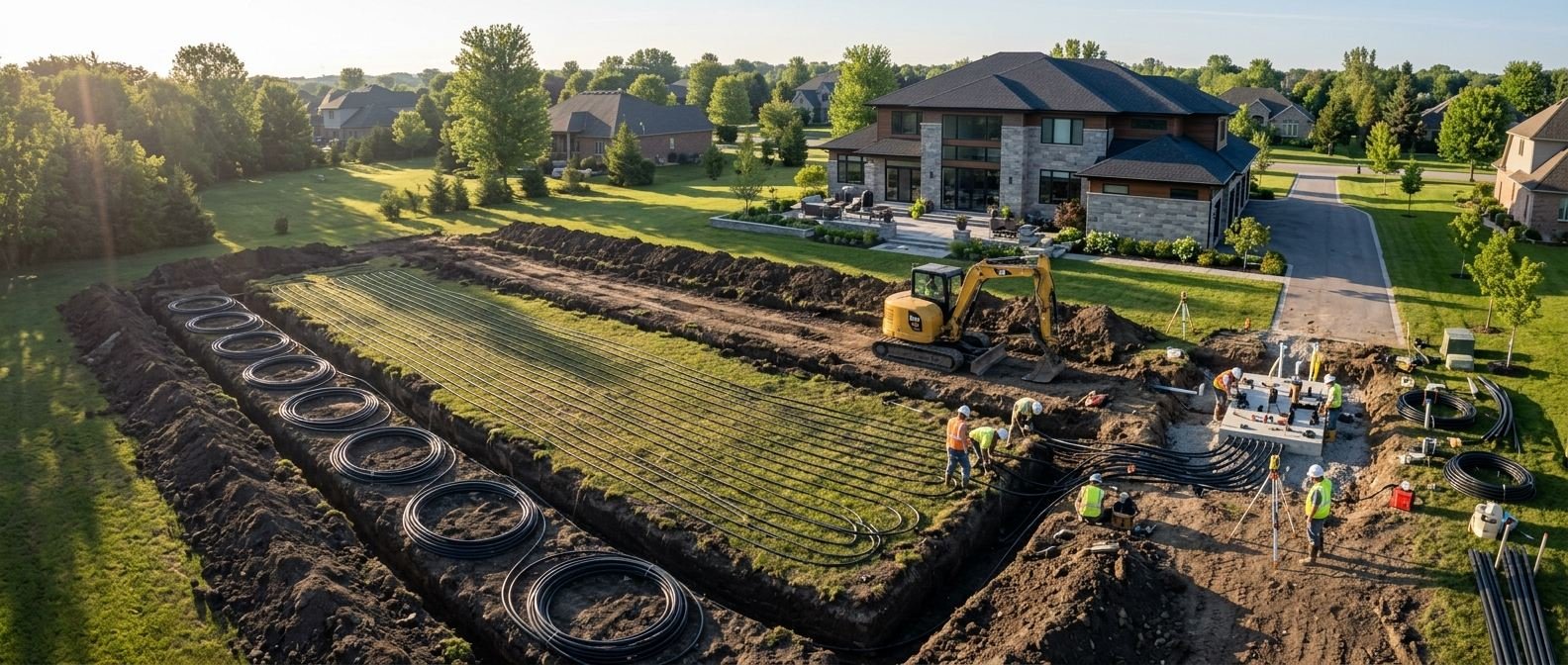
Horizontal loops are installed in shallow trenches, typically 5 to 8 feet deep. Multiple runs of pipe are laid in trenches that extend across the property. This configuration requires more land than a vertical system but avoids the cost of deep drilling, making it a cost-effective option when adequate land is available.
Horizontal loops are well-suited for new construction sites, acreages, and rural properties where there is sufficient open space. They work particularly well on properties with good soil conditions that hold stable temperatures at shallow depths.
- Generally lower installation cost than vertical drilling
- Well-suited for properties with ample land area
- Ideal for new builds and acreages
- Requires more surface disruption during installation
Pond / Lake Loop
For properties located near a suitable body of water, a pond or lake loop can be a highly efficient option. Coiled pipe loops are submerged and anchored at the bottom of the water body, using the water's relatively stable temperature as the heat exchange medium. This eliminates the need for drilling or trenching entirely, often making it the most cost-effective loop option when water access is available.
- No drilling or trenching required
- Highly efficient where a suitable water body is available
- Requires adequate water depth and volume
- Subject to local water body and environmental regulations
Which loop type is right for your property? We assess each site individually — lot size, soil composition, available land, and proximity to water — before recommending a configuration. There is no one-size-fits-all answer, and we won't recommend a loop type that doesn't suit your property.
Loop Configuration Comparison
| Loop Type | Land Required | Installation Method | Best For |
|---|---|---|---|
| Vertical Closed-Loop | Small footprint | Drilling (150–400 ft deep) | Smaller lots, urban/suburban properties |
| Horizontal Closed-Loop | Large area required | Trenching (5–8 ft deep) | Acreages, new construction, rural sites |
| Pond / Lake Loop | Waterfront access | Submerged coils | Properties near suitable water bodies |
| Open Loop | Minimal | Well-based (uses groundwater) | Sites with a reliable, tested aquifer |
Our Loop Field Installation Process
Calgary Geothermal handles every phase of loop field installation in-house. From site evaluation through pressure testing and backfill, our team manages the work directly — no subcontracting.
Site Evaluation & Loop Design
Before any digging or drilling begins, we evaluate the property in detail. We assess soil and ground conditions, measure available land, determine the appropriate loop configuration, and calculate the required loop length based on the building's heating and cooling load. This design work ensures the loop field will be properly sized — neither undersized nor oversized — for long-term system performance.
Permits & Regulatory Approvals
Loop field installation in Calgary requires permits for drilling or excavation. We handle all permit applications and regulatory requirements on your behalf. For pond or lake loops, we also manage any required environmental approvals. You don't need to navigate the paperwork — we take care of it.
Drilling or Trenching
Our crew completes the drilling or excavation using appropriate equipment for the site conditions. Vertical borehole drilling is completed with minimal disturbance to surrounding landscaping. Horizontal trenching is laid out to maximize heat exchange area within the available space. All work is completed with care for the property.
Pipe Installation & Heat Fusion
High-density polyethylene (HDPE) pipe is inserted into boreholes or laid in trenches. All pipe joints are heat-fused — not glued or clamped — creating a continuous, leak-free connection that is designed to last the full life of the system. Proper pipe fusion is essential, and we treat it as a non-negotiable part of every installation.
Pressure Testing
Every loop field is pressure-tested before backfill. This confirms there are no leaks before it's buried. We don't skip this step — ever. A loop failure discovered years after installation is far more costly and disruptive than catching it on day one.
Backfill & Site Restoration
Once the loop passes pressure testing, boreholes are grouted and trenches are backfilled. We take care to restore the site as closely as possible to its original condition. Surface disturbance from vertical systems is minimal; horizontal systems require more restoration, which we discuss with you in advance.
Frequently Asked Questions
For a typical residential vertical loop, drilling and pipe installation usually takes 2 to 5 days. Horizontal trenching on an acreage may take a similar amount of time depending on the total trench length. This is followed by pressure testing, grouting or backfill, and connection to the header. The full loop installation phase, from mobilization to complete backfill, is typically done within one week for most residential projects.
A horizontal loop for a typical Calgary home generally requires 1,500 to 3,000 square feet of open, accessible land — though this varies depending on the total loop length needed, soil conditions, and trench layout. Properties with limited yard space are usually better suited for vertical drilling. We assess your site and will tell you clearly whether horizontal is a viable option for your property.
Vertical boreholes in the Calgary region are typically drilled to depths of 150 to 400 feet, depending on the building's heating and cooling load, soil conductivity, and available lot space. Deeper boreholes access more stable ground temperatures and allow for a smaller surface footprint. We determine borehole depth as part of the system design process for each specific property.
We use high-density polyethylene (HDPE) pipe, which is the industry standard for geothermal ground loops. HDPE is flexible, corrosion-resistant, and highly durable underground. All joints are heat-fused rather than glued or mechanically connected, creating a permanent bond that maintains loop integrity for the life of the system — typically 50 years or more.
Yes. Vertical loop installations are commonly done on established residential properties because the surface disturbance is limited to borehole locations and a small header trench. Horizontal installations require more disruption to the yard and are better suited for properties during or before landscaping. We discuss the extent of surface work with you before the project begins so there are no surprises.